Essay
Why every Voice Memo you've ever recorded belongs in one document
Your individual recordings aren't where the value is. The combined document is. Here's what changes the moment you put them all in one place, and why it matters more now than it ever has.
Voice Memo Exporter does this in one pass: every memo into one searchable Master Transcript. $49 early access, runs privately on your Mac.
Get Early Access - $49 (Gumroad)I have somewhere around six hundred Voice Memos.
I don't know the exact number because I've never been able to face it. Years of walks where I talked through an idea. Drives where I worked out a problem. Two-in-the-morning recordings I made because I didn't trust myself to remember the thought in the morning. Half of them I've forgotten exist. The other half I remember vaguely - "I know I said something good about that, somewhere."
The recording isn't the problem. Apple made the recording part easy. The problem is what happens after.
Each Voice Memo is a single point. A flash of thinking, isolated from the others. You can play it back. You can transcribe it, if you scroll to the right tab. You can copy the text out. But you can't do much with one recording. The interesting thing about a year of voice memos isn't any individual one. It's the pattern across all of them. The ideas you kept coming back to. The questions you've been quietly asking yourself for nine months. The chapter you've been talking around without realizing it.
You can't see any of that from inside the Voice Memos app. The data is there, but the shape isn't.
The shape problem
A Voice Memos library is a list. Long, scrollable, sorted by date, named whatever Apple felt like naming it. "New Recording 213." "New Recording 214." You can search inside one recording's transcript on a recent Mac, but you can't search across all of them in any meaningful way. You can't ask "everything I've said about this topic." You can't ask "what did past-me think about this in March." You can't ask anything at all, really. You can just scroll.
The format is the prison. Every recording is its own little document, and humans aren't very good at synthesizing across hundreds of little documents in their heads.
The fix isn't more recordings, or better transcription, or a smarter app. The fix is structural. You need to change the shape of the data, from a list of separate recordings into one combined document. That's it. That single change makes almost everything else possible.
I started calling it a Master Transcript because I needed a word for it, and that's what it is: one document, every transcript, in order, with the dates attached. Months of thinking, laid out end to end, in a file you can open in any text editor.
The first time I built one for myself, I sat there reading it for an hour. I'd forgotten I'd been thinking about half of those things.
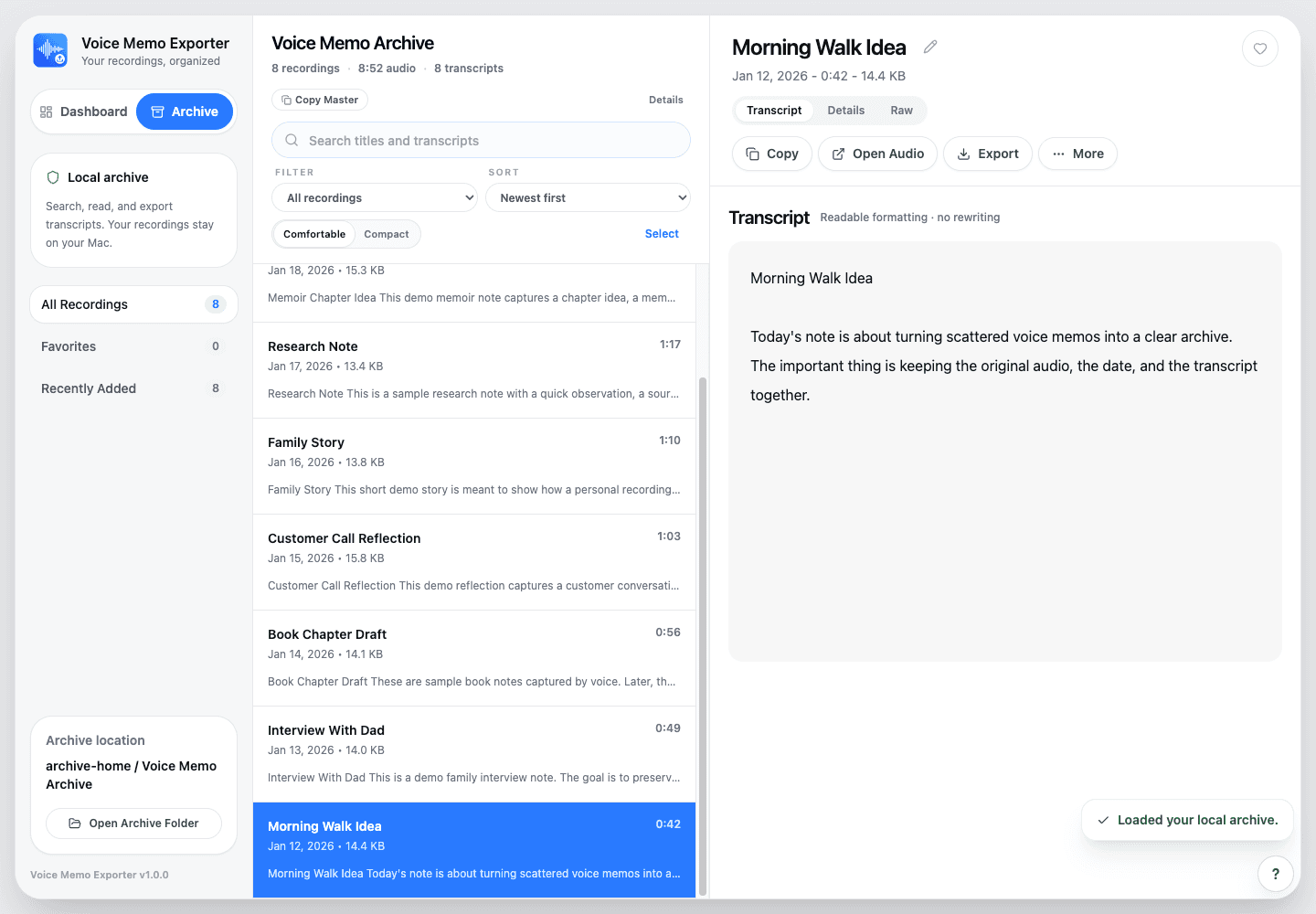
There's a faster way than doing this by hand.
Voice Memo Exporter does the steps above in one pass: every Apple Voice Memo on your Mac exported, transcribed locally, and combined into one searchable Master Transcript. $49 early access, private by design.
What changes when it's one document
A Master Transcript is boring to describe. It's just a text file. The interesting part is what becomes possible the moment it exists.
You can actually search it. Cmd-F across a year of thinking. Every time you've mentioned a person, a project, a half-formed idea - there, in order, with dates. The first time you do this, you realize how much you've been losing.
You can read it linearly. Not all of it, not at once, but you can sit with a hundred pages of your own voice in a way you've never been able to. Patterns show up that you couldn't see when each thought was its own file. You see what you actually care about, instead of what you tell yourself you care about.
You can give it to other people. A ghostwriter. An editor. A family member working on a memoir with you. The raw audio isn't useful to them. The document is.
And you can give it to AI. This is the part that matters most right now, and it's the part nobody is set up for.
The AI part
Here's the thing I think most people haven't quite caught up to yet: large language models are remarkably good at reading a body of someone's thinking and finding the structure inside it. Not generating new ideas - finding the ones already there. Themes, recurring questions, contradictions, drafts of arguments you've been making for months without realizing.
The blocker has never been the model. The blocker is that nobody hands the model their actual thinking. They hand it a paragraph and ask it to expand. They hand it a prompt and ask it to invent. The output feels generic because the input was generic.
A Master Transcript is the opposite. It's a year of you, in your own words, on your own subjects. You hand the whole file to ChatGPT or Claude and you can ask things like:
“Here's a year of voice memos. What are the three biggest themes I keep returning to?”
“Pull every idea I've had about [topic] and group them.”
“This is the raw material for a book. What's the actual book?”
“Summarize how my thinking on [thing] has changed over time. Quote the recordings.”
The model isn't inventing. It's reading. And because the input is yours - specific, personal, with your phrasings and your obsessions and your loose ends - the output is yours too. It's recognizable in a way generic AI output never is.
This is the leverage. A year of recordings, transformed by a structural change (list → document) into something an AI can actually work with. The model doesn't add anything. It just sees what was already there, because you finally let it.
Why this is hard to do today
Apple's Voice Memos app, even with its transcription feature, isn't built for this. You can transcribe one recording at a time, copy the text, and paste it somewhere. That's it. There's no batch transcription, no combined export, no Master Transcript option. If you have four hundred recordings, you have a four-hundred-step process and most people never start.
Cloud transcription services solve the batch problem but introduce a new one: you have to upload everything. For a lot of people, Voice Memos are not the kind of content you want on someone else's server. They're personal. They're business-sensitive. They're family. They're the things you record because you trust the device, not because you trust the internet.
So most people end up doing nothing. Years of recordings sit in the app, valuable in theory, useless in practice.
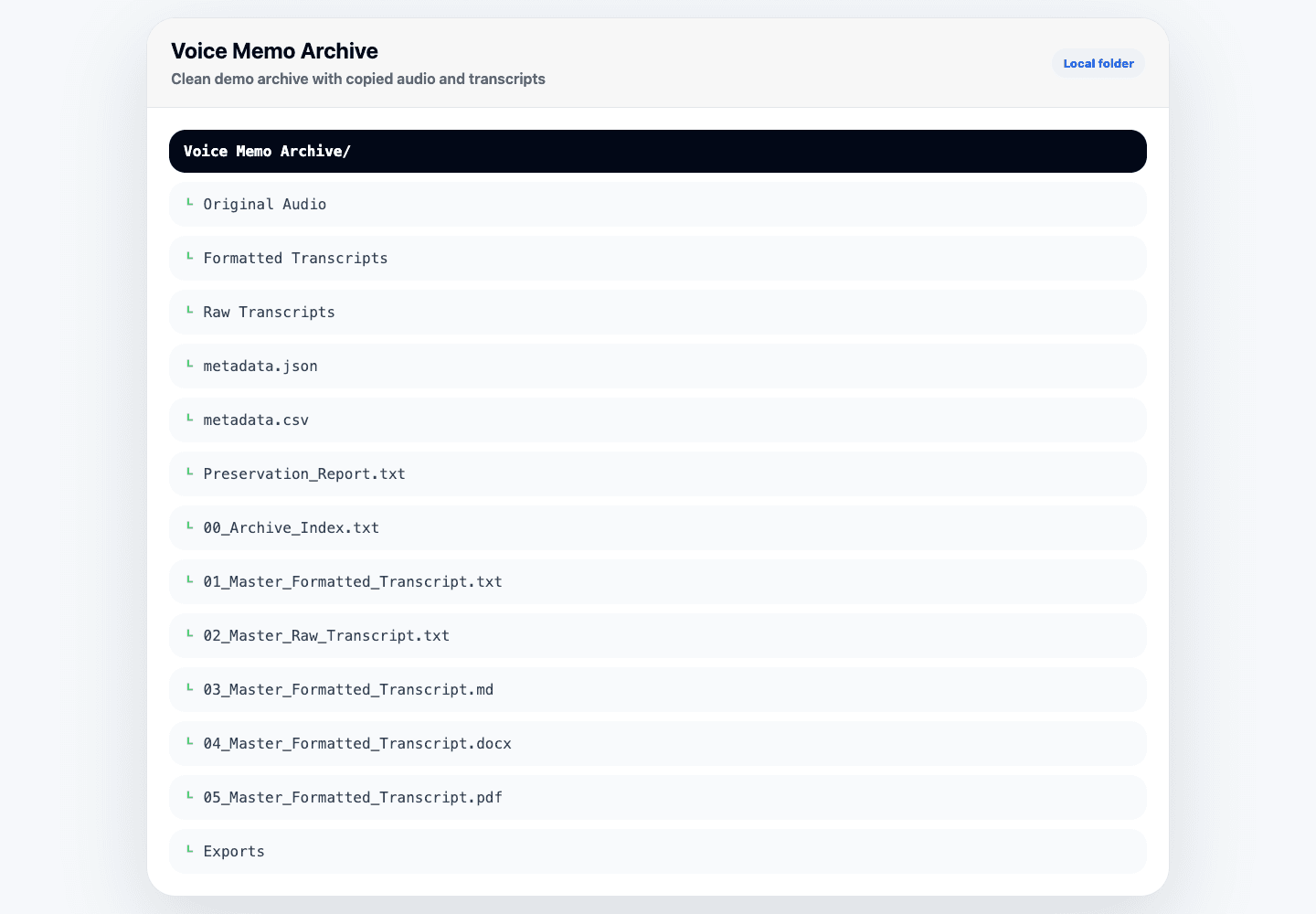
This is the gap I built Voice Memo Exporter to fill. It runs on your Mac, finds your Voice Memos, copies the audio into an archive folder you control, transcribes everything locally so nothing leaves your machine, and combines all the transcripts into one Master Transcript. TXT, Markdown, DOCX, or PDF, your choice.
Markdown matters because it stays clean when you move the work somewhere else. It is readable in a text editor, useful in notes apps, and easy to paste into ChatGPT, Claude, Obsidian, Notion, or a writing workspace without dragging along a pile of formatting.
It is, intentionally, a boring app that does one specific thing. The interesting work isn't the app - it's what you do with the document you get out of it.
A note on what this isn't
A Master Transcript isn't a substitute for thinking. It's not magic. The transcription is best-effort. Clear speech transcribes well; noisy rooms, overlapping voices, and music are still hard. You'll have rough patches in the document. You'll have recordings that didn't transcribe at all.
That's fine. The document is still the most valuable file on your computer. A few imperfect lines in a hundred pages of your own thinking is a wildly favorable trade.
And the audio is preserved either way. If a transcript is rough, you can go listen. The archive holds.
What to do with this
If you've got more than a hundred Voice Memos and you've never been able to use them for anything, here's the move:
Build a Master Transcript. Read it. Give it a week. Search it for the topics you care about. When you want to work with it somewhere else, copy the Markdown Master Transcript and paste it into Claude, ChatGPT, or your writing workspace.
Then decide what you want to do with the thing you've actually been thinking about for the last year.
That's the whole point. The recordings were never the point. The document was. The recordings were just where you kept the document, before you knew what it was.
Build your Master Transcript.
Voice Memo Exporter turns years of Apple Voice Memos into one searchable document on your Mac - copied audio, individual transcripts, and a combined Master Transcript you can export as TXT, Markdown, DOCX, or PDF. Runs locally. No cloud upload.
Get Early Access - $49$49 one-time · Forever license · No subscription · No cloud upload
First 100 buyers at $49, then $79. 30-day refund if it doesn't work for your Mac setup.